Intuitive Machines Claims Top Trading Spot as Space Stock Plunges 12.7% on Sector Fear and Valuation Jitters
Market Snapshot
Shares of Intuitive Machines (LUNR) experienced significant volatility and heavy trading activity on June 5, 2026, closing down 12.70% amid intense investor scrutiny. The stock recorded a trading volume of $0.42 billion, ranking as the most actively traded equity in the market for the day. This sharp decline occurred despite a robust recent performance, with the stock up 35.6% over the past month and 88.1% year-to-date, suggesting a profit-taking phase or a reaction to broader sector-specific concerns. The heavy volume indicates a significant shift in sentiment, as investors reassess the valuation of the space infrastructure company following a series of major corporate announcements and external industry events.
Key Drivers
The immediate catalyst for the 12.70% pullback appears linked to broader sector-wide caution triggered by a high-profile incident in the launch industry. Investors quickly disposed of positions in space stocks, including LUNR, following the explosion of Blue Origin’s New Glenn rocket during a hot-fire engine test in Florida. The incident, which generated seismic activity equivalent to a 2.5 magnitude earthquake, heightened concerns regarding the safety and reliability of rocket launches. This external shock caused a ripple effect across the commercial space sector, leading to a coordinated sell-off among peers such as Planet Labs and Rocket Lab, regardless of individual company fundamentals.
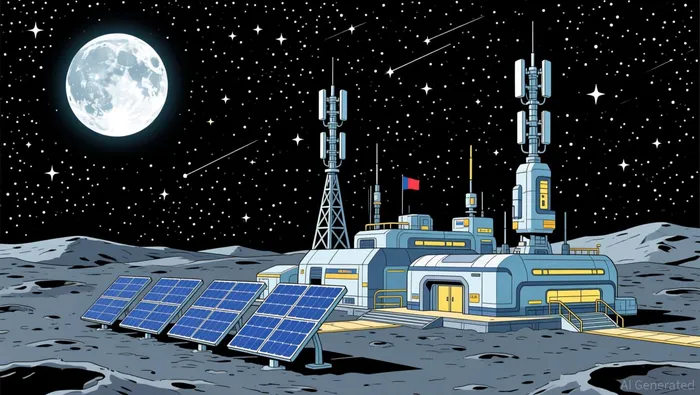
However, the decline also reflects a complex interplay between positive corporate developments and valuation pressures. Intuitive Machines recently secured the multi-billion dollar Andromeda contract from the U.S. Space Force, a ten-year agreement potentially worth up to $6.24 billion. This award marks a strategic expansion into national security space infrastructure, complementing the company’s existing NASA lunar missions. Concurrently, the company announced the acquisitions of the Goonhilly Earth Station in the U.K. and COMSAT in the U.S. to expand its global space-to-ground communications network. While these moves position the company for recurring service-based revenue, the market reaction suggests skepticism regarding the execution risks and the capital intensity required to integrate these assets.
A critical factor weighing on investor sentiment is the company’s reliance on external funding to support its expansion. Intuitive Machines has established a $500 million at-the-market equity program, a move that underscores the capital-intensive nature of building its lunar and deep space services platform. Analysts warn that frequent capital raises and stock issuances pose a dilution risk for existing shareholders. The sharp share price volatility surrounding these announcements highlights the trade-off between funding aggressive growth and preserving shareholder value. Investors are closely monitoring how the company balances its growth ambitions with the need to manage dilution and execution risk.
Furthermore, valuation metrics indicate that the stock is priced for high expectations, which may limit near-term upside potential. LUNR trades at a forward 12-month price-to-sales multiple of 7.45x, a significant premium to the industry average of 2.51x and compared to traditional aerospace giants like Lockheed Martin and Boeing. This premium valuation assumes strong future earnings growth, yet recent analyst revisions have lowered earnings estimates for 2026 and 2027, reflecting decreasing confidence in the company’s ability to generate profits in the short term. Despite a consensus estimate for 2026 sales growth of 341.9%, the expected earnings decrease of 2.4% suggests that revenue growth may not immediately translate to bottom-line profitability.
The divergence between strong contract backlogs and weak earnings forecasts creates a challenging investment narrative. While analysts highlight the visibility provided by multi-year awards like Andromeda and NASA lunar work, concerns remain about heavy reliance on a small number of large government contracts. Any delays, cancellations, or reprioritizations could significantly impact revenue. Additionally, the company’s transition from one-off mission-based revenue to a diversified model involving data and communications services is still in its early stages. Investors are advised to watch for updates on the integration of acquired assets, specific task orders under the Andromeda contract, and any changes to the capital plans under the equity program to gauge whether the company can successfully execute its strategic pivot.