Vietnam's $30 Billion Boeing Buy Signals It's Trading Airplanes for Tariff Relief
The Boeing deal looks like trade leverage, not just fleet expansion
This looks less like a routine aviation purchase and more like an effort to create a visible U.S. commercial win while the broader trade file is still open. The key signal is the $30 billion Boeing agreements, announced during a high-level U.S. visit and timed to coincide with active trade negotiations. Against the backdrop of Vietnam's large trade surplus with the United States, Washington has leverage, and Hanoi has an incentive to show flexibility before the deal is locked.
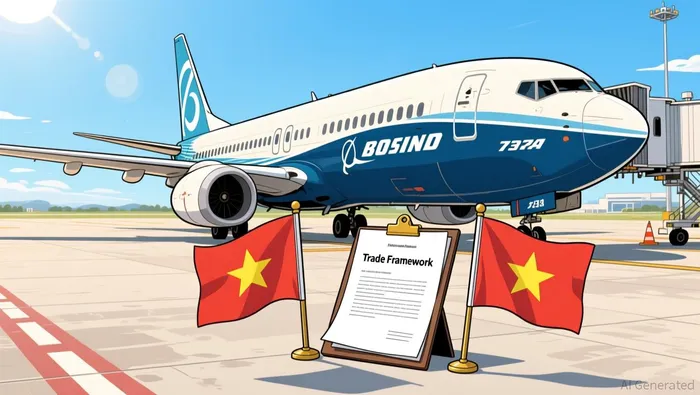
The pressure is already live. Earlier this month, the USTR opened an unfair trade practices investigation into Vietnam's IP enforcement, a process that may lead to new tariffs or other trade measures. That makes the airline story part of a wider bargaining picture.
Tariff relief is still provisional
The framework keeps a 20% tariff on most Vietnamese goods, while the products that could get relief will be decided later and the pact will be finalised in the coming weeks. That leaves businesses in limbo rather than giving them settled relief. The real prize here is not the aircraft themselves, but what Vietnam may gain in exchange before the agreement is finalized.
Why the timing points to broader trade bargaining
The speed makes more sense if the orders are read as import commitments, not just long-term seat planning.
Alongside the Boeing announcements, Vietnamese firms signed 20 memorandums of understanding covering more than $2.9 billion of U.S. agricultural purchases. Washington has been pressing on trade imbalance, and Vietnam's goods trade deficit with the U.S. reached $123.5 billion in 2024. In that context, aircraft orders stand out as large, visible U.S.-sourced spending.
Washington wanted a reciprocal deal
The White House described the framework as a way to strengthen reciprocal, fair, and balanced trade. That framing suggests the aircraft orders were not treated as a routine aviation announcement, but as part of a broader effort to show tangible U.S. commercial gains.
The delivery timeline argues against a pure capacity motive
The orders were announced during a new trade deal negotiation, while Hanoi also said it was willing to buy more American goods. Most of the Boeing deliveries are slated for 2030 and 2032, so this was not a quick response to immediate capacity needs. Vietnam Airlines is also pursuing a longer-term plan to expand its fleet to approximately 151 aircraft by 2030.
Vietnam can still frame the orders as modernization
That strategic cover matters. Vietnam Airlines has outlined a 2026-2030 loss-elimination roadmap, plans dedicated freighter aircraft from 2026, and wants a regional MRO hub at Long Thanh International Airport. That gives Hanoi a credible non-political case for the purchases even if the timing also suits trade bargaining.
A framework improves the mood, but it does not settle the dispute
The Boeing buy may help the tone of the talks, but it does not by itself resolve them.
What bulls will say
The White House already said the two sides will finalise the Agreement in the coming weeks, with the possibility that duties on certain products fall to zero later. In that reading, the aircraft orders are a sign of good faith that can help secure a smoother pact.
What bears will say
A framework is not the same as relief. Reuters noted scant details on agreement and said businesses are still waiting on clarity. The baseline pressure remains in place: the U.S. agreed to a 20% tariff on many Vietnamese exports and a 40% levy on transshipments through Vietnam. For an export hub, that higher rate could matter more than the headline tariff on end products.
There is also a process risk that Washington controls. The USTR still has an unfair trade practices investigation open, with a comment docket running through July 2. That means the broader trade file can stay active even as airlines sign papers.
The key test, then, is the fine print: product-by-product carveouts and the treatment of transshipments. If the final agreement delivers meaningful zero-duty categories and workable rules, the Boeing deal will look like useful momentum. If not, it will look more like symbolism layered on top of an unresolved tariff fight.