No, the H Token Didn't Crash
A headline has been circulating: an "H token" on BSC has plunged to near zero, trading at $0.003 on-chain while the same token on Binance sits at $0.06 - a 20-fold gap.
The headline reads like a market anomaly. It isn't. It's a taxonomy problem dressed up as a price story.
The token you're looking at doesn't exist
The real Humanity Protocol H token launched on June 25, 2025. It lives on Ethereum. It trades on centralized exchanges including Binance and KuCoin. That's the asset priced around $0.06.
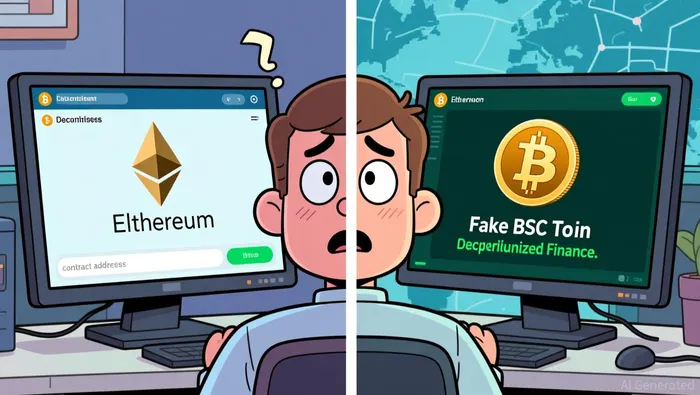
The token sitting at $0.003 on BSC (Binance Smart Chain, now also called BNB Chain) is a different contract entirely - one anyone can deploy. On BSC, deploying a BEP-20 token - the equivalent of Ethereum's ERC-20 - costs pennies in gas and requires nothing but a few lines of code. You pick the name. You pick the symbol. You set the supply. The network has no way to stop you from calling it "Humanity" and giving it the symbol "H."
Scam tokens can use the same name as a legitimate token. They cannot use the same contract address. That distinction is the only one that matters, and it's the one most traders never check.
Why the gap is 20x, not 20 cents
Here's what happens in practice: a user hears about Humanity Protocol, goes to a decentralized exchange like PancakeSwap on BSC, types "H" into the search box, and sees a token with the right name. They swap. The trade executes. But the liquidity pool is thin, the contract has no real backing, and the price collapses because there's nothing behind it but the deployer's initial pool.
Meanwhile, on Binance, someone is trading the actual H token - the Ethereum contract, the real project, the one that did a fairdrop and listed on multiple exchanges. Two different assets. Same name. Same symbol. Entirely different contract addresses.
This isn't a bug in the BSC ecosystem. It's a feature of how on-chain token issuance works: permissionless, unfettered, and fundamentally indifferent to your brand.
The deeper problem: on-chain identity is broken
This is the structural issue hiding inside a clickbait headline. In traditional finance, a ticker symbol is registered. Apple is AAPL. No one else can issue AAPL shares. In crypto, a name is a label, not an identifier. The identifier is the contract address - a long string of hexadecimal characters that the average user neither sees nor remembers.
Wallets and DEXs have started trying to help. Ethereum.org published a guide last year warning that scam tokens impersonate legitimate tokens using the same name and symbol. Uniswap's support pages now have articles about unsellable "honeypot" tokens designed to prevent you from selling. PancakeSwap's FAQ mentions that malicious issuers can suspend trading for their tokens. These are damage-control measures, not infrastructure fixes.
No one has built a trusted, chain-level name registry for tokens. Without one, the gap between what a name means in the human world and what it means on-chain will stay open.
Why this matters for how we think about on-chain settlement
I'm more interested in what this reveals than in who lost money on this specific scam contract. The H token incident is a micro-example of a macro problem: as crypto moves toward settlement - real payment rails, real tokenized assets, real institutional custody - the identity layer remains a free-for-all.
Tokenization is supposed to bring clarity to financial instruments. A tokenized Treasury should be a Treasury. A tokenized fund should be a fund. But if anyone can deploy a contract called "US Treasury" or "BlackRock Fund" on any chain, the trust that tokenization is supposed to build dissolves into a guessing game about which contract address is legitimate.
The centralized exchanges know this, which is why they curate listings. Binance doesn't let anyone list a token called "H" and call it Humanity Protocol. But the decentralized world has no equivalent gatekeeper - and by design, isn't supposed to have one.
That tension - between openness and trust - is the unsolved problem. Until it is, name collisions like this will keep showing up, every time a project gains enough attention to attract copycats.
What to watch
A few developments would change the picture. A widely adopted chain-level token name registry, even a voluntary one, would compress the attack surface. Wallet providers that automatically flag known scam contract addresses - rather than just flagging token names - would help on the user side. Or a regulatory framework that treats token-name impersonation the way securities law treats trading under a false name.
None of those have arrived yet. In the meantime, the lesson is simple even if it's tedious: if you're trading on-chain, the name is decoration. The contract address is the only thing that is real. Checking it takes ten seconds. Not checking it costs whatever you swapped.