South Korea's $350 Billion U.S. Decree Looks Like Tariff Insurance-And That's the Risk
Why the $350 Billion Pledge Matters More Than the Raw Number
The headline is $350 billion. The more important signal is why the money is moving now.
Motive matters more than scale
South Korea's parliament passed the U.S. investment law with 226 votes in favor, eight against, and eight abstentions. That broad support suggests the measure was driven as much by politics as by routine capital planning. Speaker Woo said the deal should help reduce tariff-risk exposure, and the backdrop matters: Trump had threatened to raise tariffs from 15% to 25% unless Seoul moved forward.
The bullish read is straightforward: Seoul is committing capital to deepen alignment with the U.S. across semiconductors, pharmaceuticals, critical minerals, energy, AI, and quantum computing, using a dedicated vehicle to execute the MOU.
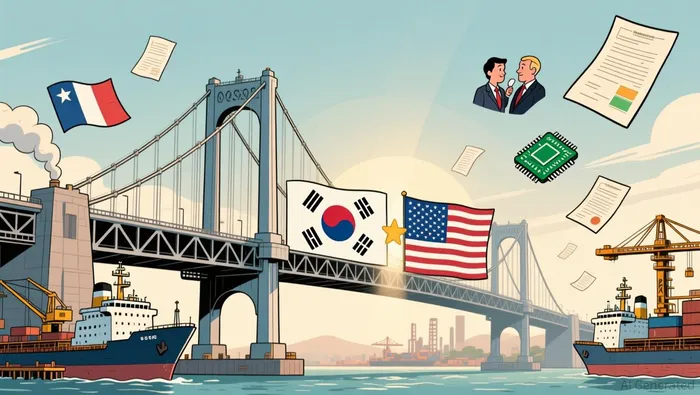
The bearish read is sharper. This may be tariff insurance rather than a clean signal of commercial conviction. The law allows projects to proceed even when profitability is weak if national security or supply-chain stability is at stake. The corporation will directly fund up to USD 20 billion a year, with the rest supported through loan guarantees. In other words, the pledge is large, but Korea's immediate cash exposure looks more controlled than the headline implies.
That is why the size is almost a distraction. The real question is whether this capital is buying durable access or simply buying time before the next tariff threat.
Project Selection Shows Where the Real Control Lies
The next question is not how big the pledge sounds. It is how projects get chosen and who benefits when the money starts moving.
The framework is political as much as commercial
Seoul's structure is built around $200 billion in U.S. strategic industries and $150 billion in shipbuilding-related cooperation, while the new corporation can directly fund up to USD 20 billion in U.S. investments each year. That annual cap limits direct deployment; it does not mean the full amount will be committed quickly.
Washington also retains significant influence over project selection. A joint committee led by South Korea's industry minister assesses proposed deals, and a finance minister-led committee decides whether they advance to a U.S. panel headed by the secretary of commerce, which can also propose projects. The MOU framing is even more explicit: investments are chosen by President Trump with advice from the Department of Commerce, and funding moves in tranches after instructions from the U.S. Investment Accelerator. This looks less like a standard commercial pipeline than like a politically guided capital channel.
Seoul's safeguards can slow deals, but they do not steer them
Seoul does have risk checks. The law requires commercial rationality, and exceptions tied to national security or supply-chain stability need approval from relevant parliamentary committees. But those safeguards look more like brakes than a steering wheel. They may help Seoul reject the most awkward mismatches and pace flows carefully, especially with currency risk in mind. They do not make this a normal private-equity or corporate capex story.
Investors Should Focus on Execution, Not the Headline
The bull case is narrower than the headline suggests. The clearest beneficiaries are likely to be companies already embedded in U.S. nuclear energy and shipbuilding ecosystems, along with Korean contractors that already have execution footprints in those markets.
What to watch instead of the full sector list
The current priority list includes shipbuilding, semiconductors, pharmaceuticals, critical minerals, energy, artificial intelligence, and quantum computing, but additional sectors can be added by presidential decree. More important, Reuters notes that passage of the bill would create a state-backed investment corporation with 2 trillion won ($1.4 billion) in capital and a strategic investment fund, while capstone analysis argues the administration may underestimate how long it takes to finance, build, and staff projects.
That makes the practical takeaway simple: favor companies already inside the relevant U.S. supply chains, and avoid treating the full sector list as near-term order flow. This agreement may generate headlines quickly, but actual deployment is likely to be slower and more selective than the $350 billion figure implies.