India's Fiscal Headline Is a Distraction - The Oil Demand Reality Isn't
One of the more dangerous habits in market commentary is mistaking a stale headline for a live thesis. A recent headline claiming India is willing to let its fiscal gap widen to as much as 4.8% of GDP circulates with the air of breaking policy. The problem is that 4.8% was the FY2025 figure from the February 2025 budget. India has already moved past it - the revised estimate for FY2026 is 4.4% of GDP, and the FY2027 budget target is 4.3%. The deficit isn't widening. It's shrinking. The fiscal story is one of consolidation, not stimulus.
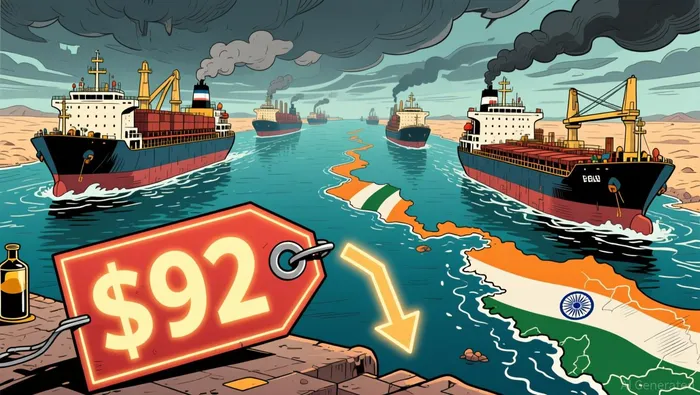
While it's true that the headline grabs attention, it misses the number that actually matters for energy investors: what is happening to India's oil demand as the Strait of Hormuz crisis forces crude prices to $92 per barrel, roughly $20 above the pre-crisis level. That is the primary driver. India consumes around 5.5 million barrels of crude per day and imports nearly all of it, making it the world's third-largest crude buyer. When the Indian rupee weakens against the dollar and crude jumps $20 a barrel simultaneously, the import bill balloons - and demand bends the other way.
The data already shows it happening. India's state-owned oil marketing companies are losing approximately $18 per barrel. Their total import bill has reached $93.6 million per day, translating to roughly $34.2 billion for the year. At those numbers, the government faces an impossible choice: raise fuel prices and stoke inflation, or let the marketing companies hemorrhage and drain the fiscal balance sheet they've been trying to repair for two years.
Now let's talk about what the primary sources say about where this is headed. The IEA's May 2026 Oil Market Report - the one everyone should be reading instead of recycled fiscal headlines - forecasts global oil demand contracting by 420,000 barrels per day for the year, down 1.3 million barrels per day from its own prior forecast. The Hormuz crisis is the named driver. India is the single most important growth market in the global demand model. When Indian demand slows or reverses, the whole number contracts.
OPEC echoes the concern, though with less severity. Its May report cuts 2026 global oil demand growth to 1.17 million barrels per day, down from 1.38 million per day in the prior cycle. Both agencies agree on direction, not magnitude. That disagreement is normal - both are inputs, not authorities. The shared conclusion is what matters: the growth story is broken for now.
From an energy investment perspective, this creates two simultaneous but separate dynamics. On the supply side, Hormuz disruption keeps a geopolitical floor under prices. As long as the strait is a risk, crude doesn't crash to pre-crisis levels even if demand collapses. That's the premium. On the demand side, India's pain is real and it's measurable. India now imports from around 40 different countries, a diversification strategy that buffers supply risk but doesn't solve the price problem. You can find crude everywhere when it costs $92, but you still have to pay for it.
This does not mean oil demand is permanently destroyed; it means growth is suspended. The EIA's June 9 outlook expects oil demand to rebound by 2.5 million barrels per day in 2027, assuming prices drop and Hormuz supply flows return. That's a big rebound. But 2026 is the year of the contraction.
All things considered, the India fiscal headline is noise. The deficit trajectory is disciplined - 4.8% to 4.4% to 4.3% - and tells you the government is tightening, not spending its way out. The investable reality is that India's oil demand growth has hit a wall driven by the Hormuz crisis, elevated crude prices, and a weakening rupee. For energy investors, that means global demand models for the remainder of 2026 should be built around contraction, not growth. Midstream and pipeline names with fee-based revenue and low commodity exposure look like the right side of this trade. E&P producers with strong balance sheets can ride the geopolitical premium while the demand shock absorbs itself. There's better out there than betting India's fiscal gap becomes the story - because it won't be.