Level 2 data on a crypto exchange, and what it signals about who builds the next trading stack
Bitget announced last week that eligible VIP users can now access free Level 2 US stock market data - real-time order-book depth from Nasdaq TotalView and Blue Ocean feeds, the same professional-grade data that brokers charge for in traditional markets.
If your first thought was "a crypto exchange giving out stock market data?", you're reacting to the right weirdness - but I think the headline feature isn't the data. It's what has to already be true for the data to make sense at all.
The stack underneath
Bitget doesn't let you buy actual Apple or Amazon shares. What it offers are tokenized stocks and stock perpetual futures - digital tokens whose prices track US equities - which are derivatives settled in stablecoins. You trade them 24/7 against USDT, and the price stays tethered to the real market through oracles and liquidity providers.
Level 2 data - which shows you the full depth of bids and asks across multiple price levels, not just the best price - is useful for these products. If you're trading a tokenized version of Tesla, seeing the actual Nasdaq order book helps you understand where real supply and demand sit, so you can time entries on the synthetic version more precisely.
But the data was only worth offering because Bitget has already spent months building the rest of the stack. In January, it launched tokenized stock products. In early June, it rolled out "Stocks 2.0," powered by a licensed RWA platform called Reality Protocol, which links tokenized equities to real US market liquidity and supports dividend tracking and stock splits. Now it's layering professional market data on top.
The sequence matters: synthetic product, then liquidity architecture, then professional tooling. That's the order in which a platform becomes something that looks like an exchange.
Everyone is building the same thing
Bitget isn't alone. Binance announced on June 1 that it would offer US stock and ETF trading with 24/5 availability. Bybit, which introduced traditional-asset CFDs back in 2022, just doubled down on zero-fee stock CFD trading in early June. Phemex has been marketing itself as a TradFi-crypto hybrid since early this year.
I find the speed of convergence surprising. These platforms spent years trying to convince people that crypto-only was the point. Now they're stacking equities, futures, data feeds, and gold access into what they call "one-stop trading." The product pitch is convenience, but the structural move is something different: they're building parallel trading infrastructure, not waiting for traditional finance to catch up.
Two tokenization paths, one question
Here's the part that keeps me up at night. The SEC is preparing a formal framework for tokenized stock trading. Nasdaq filed a rule change to allow trading in tokenized securities on its exchanges, and the SEC has signaled it may permit trading of tokenized shares without the prior consent of the issuing companies. This is top-down tokenization - regulated, custody-compliant, settling through established channels.
Meanwhile, Bitget and its peers are tokenizing from the bottom up. Their products don't require SEC approval or issuer consent because they're synthetic - price-tracking tokens, not ownership claims. US persons are generally excluded. The legal category is fuzzy on purpose.
These two paths don't have to collide, but they're competing for the same user question: "How do I get equity exposure on a platform that never sleeps, doesn't require a wire transfer, and lets me trade with a phone?"
The regulated path will win on legitimacy. The crypto-native path will keep winning on speed and access for non-US users. The tension between them is the story - not whether either model survives.
What the data layer tells us
Back to Level 2. Market data is the plumbing that professional traders rely on to see what's happening beneath the quoted price. Brokers have charged for it because it's expensive to license and it signals seriousness.
When a crypto exchange gives it away, two things are happening simultaneously. First, it's lowering the barrier for retail traders to use professional tools - which is the stated goal. Second, it's signaling that the platform wants to be evaluated as a trading venue, not as a novelty. The data makes the synthetic products feel less synthetic, and that perception shift is the whole point.
Where the friction shows up
I should flag what I couldn't verify: the actual trading volume on Bitget's tokenized stock products. The platform has been accumulating it since January and claims strong growth, but I don't have an independent figure to put alongside it. Volume is the test of whether this infrastructure is being used or just built. Without it, I can map the architecture but not yet the demand.
What I can observe is that every major crypto exchange that has added TradFi products in the past six months has done so with the same architecture: synthetic exposure, stablecoin settlement, around-the-clock access, increasingly professional tooling. The pattern is too consistent to be coincidence.
What changes
The obvious question is whether crypto exchanges are becoming brokerages. I think that's the wrong frame. Brokerages move ownership. These platforms move price exposure. The distinction matters because it determines what happens when things break - and it determines who regulates them, if anyone.
What's changing is that the boundary between "crypto trading platform" and "multi-asset exchange" is collapsing from the crypto side, even as the SEC and Nasdaq are trying to formalize the same convergence from the regulated side. Two construction crews, one bridge.
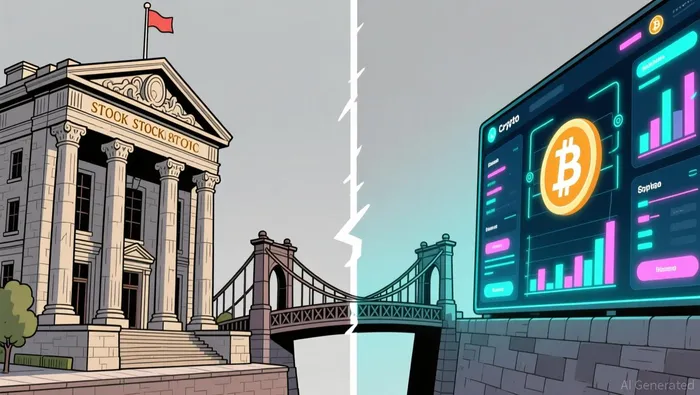
The open question is which side produces a settlement layer people actually trust at scale. The crypto-native model moves faster. The regulated model has the DTC and clearinghouses. Right now, I think the answer depends less on technology than on what happens when one of these systems encounters a stress event that tests whether synthetic exposure holds up when real markets don't.
That's the test the Level 2 data feeds were probably designed to make traders feel ready for.